Why do cats knead blankets (and you)?
Check these signs first
- Red flag: Go to the vet today if your cat2 signs
- Yellow flag: Make an appointment within the next few days if3 signs
- Reading time
- 4 min
- Sources
- 5
- Updated
Kneading is normal behavior left over from kittenhood: kittens push their paws against their mother to get milk flowing, and many adult cats keep doing it when they're relaxed and content. You don't need to stop it. It's only worth asking your vet if your cat kneads obsessively, suddenly kneads much more than before, or sucks on and eats fabric.
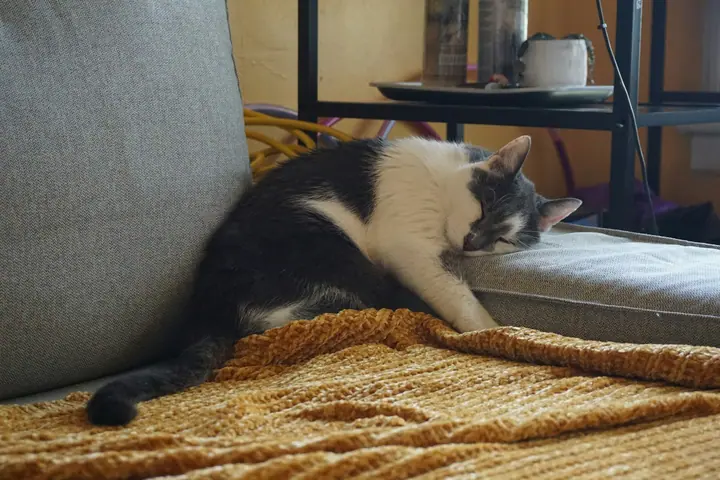
Why cats knead
Nobody knows for certain what kneading does for an adult cat: behavior experts are still debating it. These are the best-supported explanations, and several probably apply at once:
- A leftover from nursing. This is the most widely accepted theory. For a kitten, kneading meant milk, warmth and safety, and the motion stays linked to that feeling for life.
- Comfort. Cats tend to knead at calm moments: before a nap, on your lap or on a soft blanket.
- Making a bed. Tamping down a surface before lying on it may come from their wild ancestors. This idea has less support than the others.
- Leaving their scent. Cats have scent glands between their paw pads, so kneading may mark the blanket, or you, as familiar and theirs.
- Stretching. Some experts think it also helps cats stretch their muscles and relieve tension in their legs.
- Affection. When a cat kneads you, it can be a sign of affection. Take it as a compliment.
What if my cat kneads and sucks or bites the blanket?
Some cats suckle on a blanket while they knead, mimicking nursing. As long as it's only sucking, it's usually not a problem.
Chewing and swallowing bits of fabric or wool is different. It's called pica, and it's more common in breeds like the Siamese, Burmese and Tonkinese, although any cat can develop it. The risk is real: fabric can cause an intestinal blockage, which often means surgery. Stress, boredom or an illness can be behind it, so it deserves a vet visit.
What to do when the claws hurt
- Trim the tips of the claws regularly. If you're not sure how, ask your vet's team to show you.
- Put a thick blanket on your lap, or gently move your cat to "their" blanket when the kneading starts.
- Never punish your cat: no yelling, hitting or spray bottles. It isn't misbehaving, and punishment causes fear and anxiety that can make the behavior worse.
You don't need to prevent it, either. It's an instinct that needs an outlet; a place to knead that doesn't bother you is enough.
When to see the vet
Go to the vet today if your cat:
- Has swallowed a piece of fabric, wool or string and is vomiting, has diarrhea or constipation, seems lethargic or is eating less: these are signs of an intestinal blockage. See also why a cat throws up.
- Has a string coming out of the mouth or the bottom: don't pull it.
Make an appointment within the next few days if:
- Your cat kneads obsessively or much more than before: it may be self-soothing because of anxiety or pain, for example from an injury or arthritis.
- Your cat sucks, chews or eats fabric often.
- Your cat is also licking itself bald: read why a cat loses hair.
What the vet will do
Your vet will ask when it started, how long it lasts and whether anything has changed at home, and will examine your cat to rule out pain. If your cat eats things that aren't food, they may run blood, urine and fecal tests to look for a medical cause. A routine exam costs about $57-$130 in the US (Synchrony/CareCredit 2025-2026 cost study).
If everything checks out, the work happens at home: more play (fishing-rod toys work well), steady routines, keeping tempting fabrics out of reach and, sometimes, changes to how you feed. In difficult cases your vet may refer you to a behaviorist or prescribe anti-anxiety medication.
Frequently asked questions
Does kneading mean my cat is happy?
Usually, yes: it's a sign of comfort and trust. The exception is kneading that suddenly increases or becomes obsessive; then it may be your cat's way of calming down, and it's worth a vet check.
Why doesn't my cat knead?
Not every adult cat keeps the habit, and that's fine. Cats show they're content in different ways.
Do cats knead because they were weaned too early?
It's a popular idea, but it isn't proven. Early weaning has only been linked to fabric eating in one particular breed, not to kneading. Kneading is an instinct that many cats simply keep as adults.
Why does my cat knead right before sleeping?
It's when they're most relaxed, and they may also be arranging the spot. It's part of their bedtime routine.
Sources
This article is for general information and does not replace diagnosis or treatment by a veterinarian. If you are worried about your pet's health, call your vet clinic.