Dogs and fireworks: how to help your dog with the fear
Check these signs first
- Red flag: Go to the vet right away if your dog4 signs
- Yellow flag: Make an appointment in the next few weeks if4 signs
- Green flag: What you can do at home on fireworks night
- Typical cost
- $56-$129
- Reading time
- 6 min
- Sources
- 9
- Updated
If your dog trembles, pants, hides or tries to bolt when fireworks go off, the fear is real, not drama. On the night, let your dog hide somewhere quiet, close the windows and blinds, turn on the TV or music, stay with them and don't scold them. If the fear is intense, book a vet visit a few weeks before the Fourth of July or New Year's Eve: there are treatments that work, but they take time.
Why fireworks are so scary
Dogs hear far better than we do, and fireworks are loud, sudden and impossible for them to locate. In a University of Bristol study, almost half of owners described at least one sign of fear in their dog when exposed to noises, and fireworks were the most common trigger, ahead of thunder and gunshots. Yet fewer than a third had sought professional help (University of Bristol).
The fear rarely goes away on its own: without treatment, each fireworks season can be worse than the last (Dogs Trust).
Signs your dog is scared
The most common signs are (Dogs Trust):
- Trembling, panting or drooling heavily.
- Hiding, or the opposite: sticking to you and refusing to leave your side.
- Whining, crying or barking.
- Tail tucked between the legs, or pacing back and forth.
- Trying to escape, scratching at doors or chewing things.
- Refusing food or having accidents in the house.
Many of these signs also show up when dogs shake for other reasons: see why is my dog shaking?
When to see a vet
Go to the vet right away if your dog:
- Got hurt trying to escape (mouth, nails or paws), or ran off and may have been hit by a car.
- Chewed or swallowed a firework, even an unused one: it can cause vomiting, damage to organs like the kidneys or liver, and seizures. Call the Pet Poison Helpline at (855) 764-7661 or the ASPCA Animal Poison Control Center at (888) 426-4435 (a fee may apply) on the way (Pet Poison Helpline).
- Has burns on the nose, mouth or paws.
- Can't stop panting and won't settle, is very weak, collapses or has a seizure.
Make an appointment in the next few weeks if:
- Your dog has a hard time with fireworks, thunderstorms or other loud noises, or gets worse every year.
- The fear makes them destroy doors, hurt themselves or have accidents in the house.
- Your older dog has suddenly become afraid of noises: a health problem, such as pain, may be behind it.
- You'd like to try medication for those nights. It's best to test it beforehand, not for the first time on the night.
Prepare ahead of time
- Talk to your vet. They'll rule out health problems and tell you whether your dog needs medication or a veterinary behaviorist.
- Set up a safe den in the quietest room, away from the street: their bed under a table covered with blankets, or their open crate. Let them use it on normal days too, so they link it with good things.
- Check the microchip and ID tag. Call your microchip company to confirm the chip is registered with your current phone number, and put a tag with your number on the collar. If your dog runs off, it's what helps most to get them back. See is microchipping required?
- Escape-proof your home: doors, windows, fences and gates your dog could bolt through. Shelters see a 30% to 60% increase in lost pets around the Fourth of July, according to American Humane figures reported by New Hampshire Public Radio (NHPR).
- Start getting them used to the noise (desensitization). Play fireworks recordings at a barely audible volume while you give treats or play, and raise the volume very gradually, only if your dog stays relaxed. It takes almost daily sessions over several weeks, so ideally start months ahead (VCA Animal Hospitals). Dogs Trust offers free recordings and guides (Dogs Trust).
What you can do at home on fireworks night
- Walk early. Give your dog a long walk in daylight and be home before dark, when fireworks start. If you have to go out later, use a harness and a well-fitted leash: a scared dog can slip out of a collar.
- Close windows, blinds and curtains, and turn the lights on so your dog doesn't see the flashes.
- Turn on the TV or music at a normal volume to cover the bangs. A fan or air conditioner also helps muffle noise.
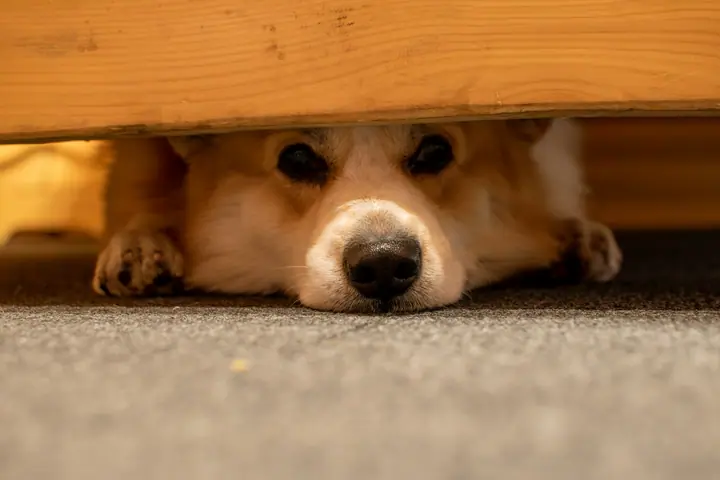
- Let your dog hide wherever they want, without pulling them out from under the bed.
- Stay with your dog. A scared dog has a harder time alone. If they come to you, it's fine to pet them and talk calmly: comforting doesn't make the fear worse, and ignoring them won't help (Dogs Trust).
- Don't scold them, even if they chew something or have an accident: it only scares them more.
- Offer something to do, like a stuffed food toy, if they're able to eat.
- Never take your dog to a fireworks show, and don't leave them alone in the yard, on a balcony or in the car.
Never give your dog human sedatives or sleep aids: they can be dangerous for dogs. Any medication must come from your vet.
The next day
Before your walk, check your yard and street: firework and rocket debris is common, and some dogs eat it. Get back to your normal routine and watch whether your dog is jumpier than usual for a few days.
Treatment: what your vet can do
Noise fear is treated by combining behavior therapy (desensitization with recordings and counterconditioning, which links the noise with something good) and, when needed, medication (VCA Animal Hospitals). Your vet may prescribe:
- Medication just for those nights, given before the fireworks start. For example, a dexmedetomidine oral gel was the first medication approved by the FDA to treat noise aversion in dogs (Zoetis).
- Daily medication through the season, for dogs with very intense fear.
Pheromone diffusers and pressure wraps can help some dogs, but as extras, not as the only treatment. A routine vet visit costs about $56-$129 in the US (Synchrony/CareCredit cost study); see how much a vet visit costs.
If your dog runs away
- Call your local shelters and animal control right away, plus the vet clinics in the area, and keep checking in person: shelters may not recognize your dog from a description.
- Call your microchip company to report your dog missing and confirm your details.
- Post a clear photo on neighborhood apps and social media, with where your dog was last seen, and keep your phone ringer on.
- Search close to home: many scared dogs hide in garages, sheds, under porches or under parked cars.
Frequently asked questions
Is it bad to comfort my dog when they're scared?
No. If your dog seeks you out, petting them and talking calmly helps. What doesn't help is getting nervous yourself, scolding them or forcing them out of their hiding spot.
Can I give my dog something to calm down?
Only what your vet prescribes. Human medicines can be toxic, and the right drug and dose depend on your dog. Book a visit early so you can test the medication before fireworks night.
Do anxiety vests work?
They help some dogs stay calmer and are worth a try, but they don't replace a safe den, your company or treatment if the fear is intense.
What if my cat is scared too?
Cats get frightened by fireworks too. Keep them indoors that night with the windows closed, and let them hide in high or enclosed spots without disturbing them.
Sources
- Supporting your dog during fireworks (Dogs Trust)
- Sound therapy for pets (Dogs Trust)
- Treating Fear of Storms and Fireworks in Dogs (VCA Animal Hospitals)
- New insight into dog fear responses to noise (University of Bristol, 2013)
- Zoetis announces launch of SILEO for noise aversion in dogs (Zoetis, 2016)
- Fireworks (Pet Poison Helpline)
- Pets and fireworks around July 4th (New Hampshire Public Radio, July 2026)
- ASPCA Animal Poison Control Center
- Veterinary Exam and Procedure Costs (CareCredit, Synchrony 2025-2026 cost study)
This article is for general information and does not replace diagnosis or treatment by a veterinarian. If you are worried about your pet's health, call your vet clinic.