How much does a dog X-ray or ultrasound cost in 2026?
Guide summary
- Typical cost
- $150-$500
- Reading time
- 4 min
- Sources
- 8
- Updated
Dog X-rays in the US usually cost about $150 to $250, though prices range from $75 to $500 (MetLife Pet). An ultrasound costs more: about $350 to $880, with a national average around $453 (MetLife Pet). The Synchrony/CareCredit 2025-2026 cost study puts the averages at about $172 for two to three X-ray views and about $483 for an ultrasound (CareCredit). Add the exam fee, and sedation if your dog needs it.
Typical costs by test
| Test | Typical cost |
|---|---|
| X-rays (two to three views) | about $172 (national average) |
| X-rays, typical range | $150-$250 (can be $75-$500) |
| Ultrasound | $348-$883 (average about $453-$483) |
| CT scan | about $1,615 (national average) |
| Sedation, if needed | $39 (oral) to $244 (deep) |
| Routine exam fee | $56-$129 |
Averages from the Synchrony/CareCredit 2025-2026 study of veterinary practices; ranges from MetLife Pet (X-rays, September 2025; ultrasound, May 2026). Emergency hospitals and specialists charge more. Always ask for an estimate.
X-ray or ultrasound: what each one shows
They aren't interchangeable. Your vet chooses based on what they're looking for, and sometimes orders both.
X-rays are best for bones, the chest and dense objects. They can show arthritis, fractures and bone tumors, heart enlargement, pneumonia and other lung disease, bladder and kidney stones and swallowed objects in the stomach or intestines (VCA Animal Hospitals). Two caveats: plastic, fabric and wood don't show up on X-rays, and locating a problem accurately takes more than one view (Animal Medical Center). That's why you're usually billed for two or three.
Ultrasound is best for looking inside soft organs in the belly: liver, kidneys, bladder, intestines and uterus. It works in real time, is painless, and most dogs lie comfortably during the scan. It can't image normal lungs or bone, because air and bone block the sound waves (VCA Animal Hospitals).
If your dog is limping, X-rays usually come first (see dog limping). For vomiting, not eating or belly pain, your vet may order both.
What makes the price go up
- Number of views: chest and hip X-rays usually need at least two.
- Sedation: most routine X-rays don't need it (VCA Animal Hospitals), and most ultrasounds don't either unless the dog is very frightened or restless. When it's needed, MetLife notes it can cost up to $100 per half hour, and large dogs need more medication.
- Biopsies: taking a sample during an ultrasound requires heavy sedation or a short anesthetic, plus the lab fee.
- A specialist: a board-certified radiologist or a mobile ultrasound specialist costs more, and the report may take a few days.
- Emergency hospitals and big cities: a scheduled X-ray at your regular vet costs less than one at an ER.
What to expect
- X-rays take a few minutes. Your dog lies on the table and staff position them; you'll often be asked to wait outside.
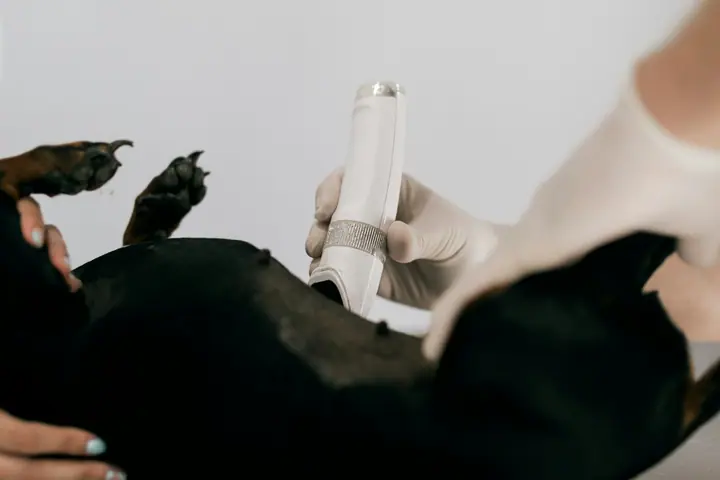
- Ultrasound usually requires shaving the fur over the area, because sound waves don't travel through air. Gel is applied and a probe is moved over the skin (VCA Animal Hospitals). The fur grows back in a few weeks.
- Ask whether your dog should fast, especially for an abdominal ultrasound or if sedation is possible. Your vet will tell you for how long.
- Never give human calming or pain medication before the visit. If your dog is very anxious, talk to your vet ahead of time.
How to save
- Get a written estimate that lists the number of views, sedation and the radiologist's report.
- Ask for copies of the images and report: if you're referred or want a second opinion, you won't pay to repeat them.
- Use your regular vet for non-urgent imaging instead of an emergency hospital.
- Check your insurance: accident and illness policies usually cover diagnostic imaging when your dog is sick or hurt. In one MetLife example, an X-ray bill of almost $850 was reimbursed over $530. See is pet insurance worth it?
If your vet also wants lab work, see dog blood work cost. Exam fees are in how much does a vet visit cost?
Frequently asked questions
Why does an ultrasound cost more than an X-ray?
It takes longer, and the result depends heavily on the skill of the person doing the scan. Using a specialist instead of a general practice vet raises the price further (MetLife Pet).
Is the radiation from X-rays dangerous for my dog?
Digital X-ray systems, now used by most clinics, give lower radiation exposure than old film X-rays (VCA Animal Hospitals). Your vet orders them when the information is worth it; if you're worried, ask what they expect to find.
Can an ultrasound confirm pregnancy?
Yes, it's the usual way to confirm it. For pregnancy checks, the fur can sometimes be dampened with alcohol and plenty of gel instead of shaved, although images are better with shaving (VCA Animal Hospitals).
When does a dog need a CT scan or MRI?
When X-rays and ultrasound aren't enough, for example to look at the spine, brain or nasal passages, or to plan complex surgery. These are done at referral or specialty hospitals; a CT scan averages about $1,615 (CareCredit).
Sources
- How Much Do Dog X-Rays Cost? (MetLife Pet Insurance, September 2025)
- How Much Does a Dog Ultrasound Cost? (MetLife Pet Insurance, May 2026)
- Veterinary Exam and Procedure Costs (CareCredit, Synchrony 2025-2026 cost study)
- Ultrasound Examination in Dogs (VCA Animal Hospitals)
- Radiology (VCA Lovers Lane Animal Hospital)
- Radiology (VCA Central Kitsap Animal Hospital)
- Digital Radiology (VCA Leon Springs Animal Hospital)
- World Radiography Day (Schwarzman Animal Medical Center, November 2025)
This article is for general information and does not replace diagnosis or treatment by a veterinarian. If you are worried about your pet's health, call your vet clinic.